
-900.jpg "Shipping Routes of Cape Verde (1)-900.jpg")
Cape Verde is an archipelagic country in the mid-Atlantic Ocean, serving as a vital maritime crossroads connecting Europe, West Africa and South America. Its shipping network consists of two core categories: international deep-sea liner routes and domestic inter-island cargo ferry routes.
Cape Verde has no direct ocean routes to Asia. All cargo from China, Southeast Asia and other Asian regions must complete transshipment at European or Canary Islands hub ports before arriving in Cape Verde’s main ports (Mindelo Porto Grande & Praia Port).
Europe – Cape Verde Main Route
This is the most mature and frequent trade lane. Regular bi-weekly liner services run between Portugal (Lisbon, Leixoes), Spain (Las Palmas, Algeciras) and Cape Verde’s two core ports: Mindelo and Praia.
Major carriers including Maersk and MSC operate this route. Imported commodities cover food, construction materials, machinery, fuel and consumer goods; exports include fresh seafood, agricultural products and light industrial goods to the EU market.
West Africa Regional Feeder Route
Short-distance feeder vessels connect Cape Verde to coastal ports of West Africa (Senegal, Gambia, Guinea-Bissau). Mindelo Porto Grande acts as the regional transshipment hub for this lane, redistributing imported cargo to West African coastal nations and collecting local fishery and mineral exports for European markets.
Transatlantic Route to Americas
Limited monthly liner services link Cape Verde with ports in Brazil and the east coast of the United States. Most shipments to North/South America rely on transshipment via Las Palmas or Tangier instead of direct calls.
.jpg "Shipping Routes of Cape Verde (2).jpg")
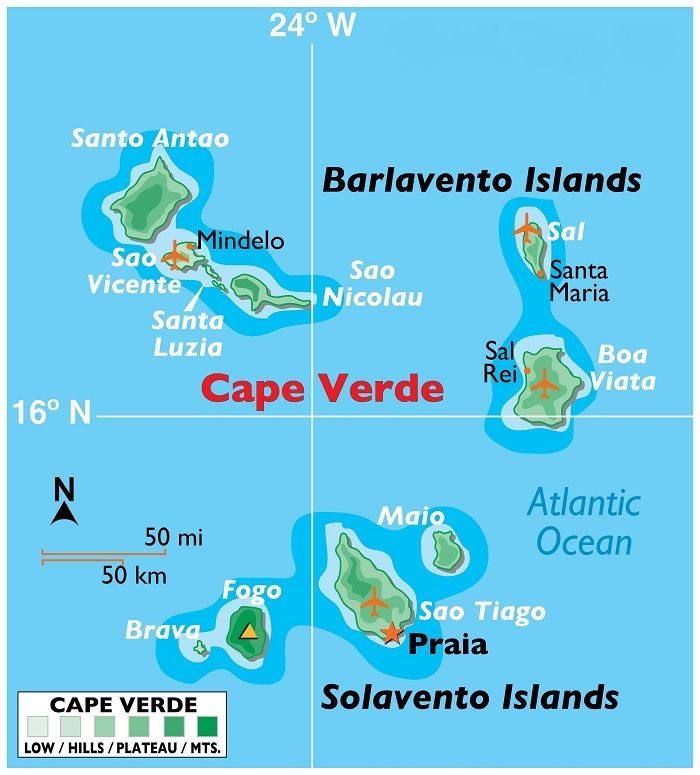
CV Interilhas is the exclusive operator of inter-island cargo-passenger ferries, responsible for distributing imported goods from Mindelo and Praia to all remote islands. Three fixed circular lines cover the entire archipelago.
Barlavento Line (Northern Islands)
Daily high-frequency service between Mindelo (São Vicente) and Porto Novo (Santo Antão). Short crossing time of about 1 hour, transporting daily supplies, vehicles and small-volume general cargo.
Redonda Circular Line (Cross-Archipelago Long Route)
Operates twice weekly, connecting Mindelo → São Nicolau → Sal → Boa Vista → Praia (Santiago). It undertakes bulk cargo distribution between northern and southern islands, with full-circuit sailing time up to 19 hours.
Sotavento Line (Southern Islands)
Three weekly rotations serving Maio, Praia, Fogo and Brava. Short short-haul segments connect small southern islands, transporting food, construction materials and fishery products.
Core Gateway Ports: Mindelo (Porto Grande) is Cape Verde’s largest deep-water transshipment hub; Praia Port serves the capital’s domestic import demand. Palmeira Port on Sal Island mainly handles fuel bulk cargo.
Transit Rule for Asian Cargo: Goods shipped from China to Cape Verde take roughly 40 days total transit time, with transshipment stopover in Las Palmas, Canary Islands.
Seasonal Restriction: Swells are heavy from November to March, which may cause delays or temporary cancellations of inter-island ferry schedules.
Cape Verde is an archipelagic country in the mid-Atlantic Ocean, serving as a vital maritime crossroads connecting Europe, West Africa and South America. Its shipping network consists of two core categories: international deep-sea liner routes and domestic inter-island cargo ferry routes.
Cape Verde has no direct ocean routes to Asia. All cargo from China, Southeast Asia and other Asian regions must complete transshipment at European or Canary Islands hub ports before arriving in Cape Verde’s main ports (Mindelo Porto Grande & Praia Port).
Europe – Cape Verde Main Route
This is the most mature and frequent trade lane. Regular bi-weekly liner services run between Portugal (Lisbon, Leixoes), Spain (Las Palmas, Algeciras) and Cape Verde’s two core ports: Mindelo and Praia.
Major carriers including Maersk and MSC operate this route. Imported commodities cover food, construction materials, machinery, fuel and consumer goods; exports include fresh seafood, agricultural products and light industrial goods to the EU market.
West Africa Regional Feeder Route
Short-distance feeder vessels connect Cape Verde to coastal ports of West Africa (Senegal, Gambia, Guinea-Bissau). Mindelo Porto Grande acts as the regional transshipment hub for this lane, redistributing imported cargo to West African coastal nations and collecting local fishery and mineral exports for European markets.
Transatlantic Route to Americas
Limited monthly liner services link Cape Verde with ports in Brazil and the east coast of the United States. Most shipments to North/South America rely on transshipment via Las Palmas or Tangier instead of direct calls.
CV Interilhas is the exclusive operator of inter-island cargo-passenger ferries, responsible for distributing imported goods from Mindelo and Praia to all remote islands. Three fixed circular lines cover the entire archipelago.
Barlavento Line (Northern Islands)
Daily high-frequency service between Mindelo (São Vicente) and Porto Novo (Santo Antão). Short crossing time of about 1 hour, transporting daily supplies, vehicles and small-volume general cargo.
Redonda Circular Line (Cross-Archipelago Long Route)
Operates twice weekly, connecting Mindelo → São Nicolau → Sal → Boa Vista → Praia (Santiago). It undertakes bulk cargo distribution between northern and southern islands, with full-circuit sailing time up to 19 hours.
Sotavento Line (Southern Islands)
Three weekly rotations serving Maio, Praia, Fogo and Brava. Short short-haul segments connect small southern islands, transporting food, construction materials and fishery products.
Core Gateway Ports: Mindelo (Porto Grande) is Cape Verde’s largest deep-water transshipment hub; Praia Port serves the capital’s domestic import demand. Palmeira Port on Sal Island mainly handles fuel bulk cargo.
Transit Rule for Asian Cargo: Goods shipped from China to Cape Verde take roughly 40 days total transit time, with transshipment stopover in Las Palmas, Canary Islands.
Seasonal Restriction: Swells are heavy from November to March, which may cause delays or temporary cancellations of inter-island ferry schedules.
Popular Articles


Categories
Share


The latest blogs and insights on what is happening in international transport and logistics.

The best freight forwarder in China who helps to optimize your global transportation with the best possible logistics solution.
